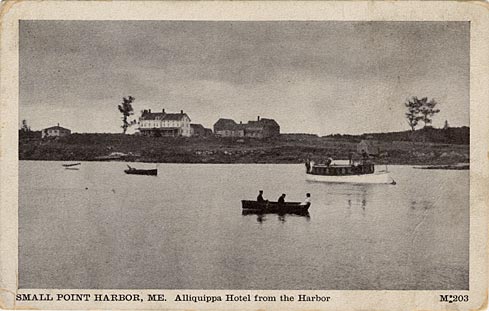
(The following summary is based on "Alliquippa: A History," Compiled by Mark Wright, copyright Mark Wright, 1989. This work can be obtained through the Patten Free Library in Bath, Maine. Special thanks also to Alliquippa alum Gail (Blumenfeld) Levy, who supplied the above postcard, dated 1907.)
1797--John Lowell of Boston purchases Small Point Harbor property, including the Alliquippa site, from John Tyng, whose family had owned land in the area for several generations.
1836--John Lowell's son Tallman Lowell builds the Aliquippa Hotel (Aliquippa is spelled with one "l" for most of its history). The hotel soon becomes a popular destination for visitors arriving by steamer from Portland and other points. Typically, guests arrive on the early boat, spend the day bathing, berrying or lounging, then return on the evening boat after dinner. The hotel earns a reputation for excellent food and enjoys many years of prosperity.
It is not known for certain how the hotel got its name, but the most common explanation is that it was named for an Indian queen of the Delaware tribe who lived near the Monongahela River in Pennsylvania. She is said to have been a friend of George Washington, who met her during an expedition in the 1750s.
1887--The Lowell family sells the Aliquippa to Samuel Sylvester, a lawyer whose investment group eventually will own Small Point Harbor, Morse Mountain, and other area properties. The hotel will be leased to a series of innkeepers over the next 30 years.
1913--Artist John Marin, one of America's greatest watercolorists, spends the summer at the Aliquippa, where he will return regularly until 1931. To view some of his paintings, including scenes painted during this period, click here. In 1913, Marin purchases, for $500, Webber's Island, which is nearly connected to the Aliquippa at low tide. To read a letter written by Marin during one of his stays at the hotel, in July, 1917, click here.
1920--Ralph Pye, a pound fisherman, purchases the Alliquippa and runs it for the next five years with his wife. The hotel declined under their proprietorship, as Pye was no innkeeper. Tension arose between the tourists and the fishing operation, which involved using the waterfront to unload fish from Pye's dories into trucks. On one occasion, Ralph's grandson Warren, said to be a strong drinker, drove a loaded fish truck into the hotel's front porch, removing a third of it.
1925--Pye sells the Aliquippa to P.R. Varian of Pennsylvania, whose family is the last to operate it as an inn. In an effort to revive the failing business, the Varians make several renovations, as summarized in the July 22, 1926 edition of the Bath Independent:
"A year has been spent in completely modernizing the Aliquippa. Spacious new verandas have been built along the west and north fronts. The guest rooms are large and comfortable; bath rooms and running water have been installed. Two homelike living rooms give ample lounging space, while big open fireplaces lend a genial warmth if the night is cool. A new kitchen has been added, and the dining room enlarged. A charming view of the harbor may be had while enjoying one's meal..."
(Robert Vogel adds: The 1925 "improvements" might well have been when the house (inn) was first wired. In the pump house during my tenure were a pair of disused Kohler gasoline engine-generators (surely now long gone) and some associated switchgear all of about that period, and a deep-well pump driven by a large electric motor of, I judge, the same period. If Central Maine Power hadn’t yet reached that far south of Bath (or Phippsburg?), it could be supposed that the Varians regarded wiring the house and producing their own electric power to have been a worthwhile and cost-effective "improvement." How, then, were things managed in the days before electricity? Lighting? by kerosene lamps, of which several still were to be found in the attic over the dining room. Cooking? on the massive hotel-scale, cast-iron coal/wood range still in the kitchen well into and past my time there. Ah, but water??? Likely a cistern somewhere near the house—long since filled in—supplied by down spouts from roof run off, the water from it pumped up to an attic tank by a gasoline-engine powered pump in an out building. Or, there may have been a similar pump down in the pump house drawing from the same deep well as the later electric pump.)
1930--A tennis court is added, and an annual tournament, the "Aliquippa Cup," begun. The improvements are not enough to save the hotel from the Great Depression, however. The Varians lease it to a woman from Philadelphia and are hoping to hold off the bank.
1932--Alliquippa ceases operation as a hotel, but doesn't close its doors altogether. Martha Hunt, sister-in-law of Newbold Varian, starts a summer camp at the site, initially with two campers. The camp will remain in business steadily for nearly 50 years. Miss Hunt is known affectionately as "Mott" by several generations of campers. During the school year, she works as a guidance counselor at the Park School in Baltimore.
(Robert Vogel adds: Mott Hunt may then have been a guidance counselor at Park, but when the Vogels arrived there in the fall of 1941, but she was also, and I think primarily, and probably before then, the girls' athletic coach, and I imagine remained so until her retirement.)
1944--A fire claims several bathrooms and most of the roof. No one is injured.
(Robert Vogel adds: The big fire was not in 1944 but in 1947, early in the summer. It didn’t burn off "nearly the entire roof," only the south roughly one-third, and the 3 or 4 third-floor smallish bedrooms immediately below. I don’t think it ever was discovered what started it, but perhaps a chink in the living-room fireplace chimney, or a spark therefrom igniting the wood shingles. Early in the season it would still have been fairly chilly, and a fire might well have been lit. In making repairs, the bedrooms weren’t restored but were replaced by the "Dormitory," which of course became the girls' quarters.)
1948--The Varians sell the Aliquippa to William Sanford, who continues the camp under Martha Hunt.
1958--Richard Wallace Jr., athletic director at the Park School, accepts Miss Hunt's invitation to help run the camp. At the time, there are about 30 campers. Dick will remain with the camp for more than 20 years. For Dick's recollections of camp life, click here.
1970s--Ownership of the Alliquippa House (now with two "l"s) passes from Sanford to the Hook Rock Corporation (principally Carolyn Mattison, with Messrs. Cooper and Stinson). The camp continues under a lease agreement, but by the late 1970s Alliquippa is again for sale.
1981--Alliquippa House is purchased by Steven Foote, an architect.
1982--The camp is permitted to operate one last summer. Later in the year, large portions of the dilapidated building are demolished. Others that can be saved are renovated and incorporated in the new Alliquippa, owned for 22 years by Foote.
2004--Foote sells the Alliquippa to a new owner, who maintains it as a private residence.
Return to Homepage